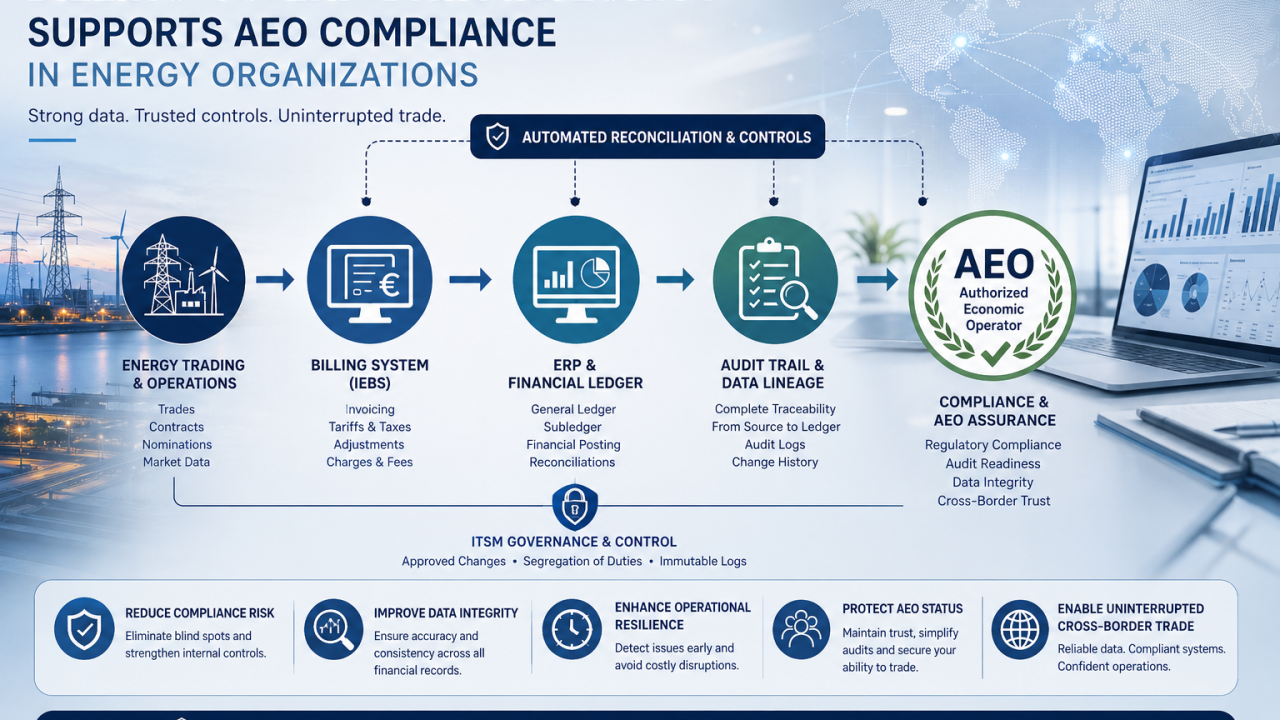
Why Energy Companies Are One Billing Glitch Away from a Regulator Fine — And an AEO Suspension
Newsletter #5 · Billing & ERP Compliance
For cross-border energy traders, generators, and major utilities, the Authorized Economic Operator (AEO) status is the ultimate golden passport. Most energy executives treat AEO compliance as a static paperwork exercise. They fail to realize it is directly tethered to the data integrity between their Billing engine (IEBS) and their core ERP.
If a billing glitch occurs, or if financial records are manually altered in the ERP background without strict ITIL governance, you aren't just looking at a regulatory fine — you are looking at a systemic compliance failure that can halt your cross-border trading operations overnight.
The Hidden Pain — Why Compliance Gaps Between Billing, ERP and Customs Occur
The IEBS-to-ERP Reconciliation Blindspot
The Billing engine processes complex retail and wholesale invoices, generating massive volumes of transactional data. When this data is pushed into the ERP's General Ledger, discrepancies inevitably occur due to rounding, unmapped tariff parameters, or late adjustments. Without automated cross-system reconciliation, these gaps remain hidden until a customs auditor uncovers them.
The "Direct Database" Ledger Fixes
When a critical billing or tariff error is discovered post-issuance, pressure mounts to fix financial reporting immediately. Administrators often bypass the application layer, logging directly into the ERP database to execute manual updates to financial tables. This shatters the end-to-end data traceability required by the AEO questionnaire.
The Compliance-to-IT Language Barrier
The Regulatory Compliance team understands the strict mandates of energy regulators and customs authorities. The IT team understands database performance and system updates. Neither side communicates effectively — leaving the organization living under the illusion that because a process exists on paper, the underlying system architecture is legally compliant.
The Fragmented Tariff Management Trap
Tariff structures, regulated charges, and specialized taxes fluctuate constantly. If these parameters are manually updated across separate silos in both IEBS and ERP without a centralized change workflow, the risk of misaligned data and systematic tax miscalculation skyrockets.
The Illusion of Standalone AEO Compliance
Many organizations treat the AEO certification as an isolated customs milestone. In reality, AEO is a high-level framework of checklists that relies entirely on data and infrastructure generated by underlying operational standards. Without a rock-solid foundation in ISO 9001 and ISO 27001, the IT compliance section of the AEO questionnaire is just an empty paperwork exercise.
The Hidden Metrics of Billing & Ledger Vulnerability
- 30–50 hours/month squandered by finance and IT teams manually reconciling mismatched billing batches between IEBS and the ERP General Ledger.
- €50,000 – €250,000 baseline exposure in potential regulatory fines and retroactive tax adjustments for systemic, undetected billing errors.
- 100% Operational Halt: the immediate risk to border-trading operations if a customs audit reveals unlogged database modifications to financial records — triggering an immediate suspension of AEO certification.
The Strategic Shift — Do / Don't
- DON'T assume standard user access controls within the ERP satisfy AEO traceability requirements → DO mandate native database auditing on all tax and financial ledger tables
- DON'T allow manual database overrides in the ERP to patch post-billing errors → DO enforce a strict policy: every financial adjustment must be executed through formal, system-logged reversal transactions
- DON'T treat the annual AEO Self-Assessment Questionnaire as a purely bureaucratic exercise → DO run joint IT and Compliance simulation audits to verify end-to-end data lineage
- DON'T hardcode tariff updates separately within application layers → DO centralize all tariff configuration changes through a governed workflow tied to official regulatory change logs
- DON'T rely on retrospective monthly reporting to catch IEBS-to-ERP interface mismatches → DO implement automated, real-time batch reconciliation flags
The "No-Code" Blueprint — Building a Compliant Ledger Architecture
1. The ITSM-Orchestrated Financial Change Loop
Any modification to tariff tables in the IEBS or financial configuration settings in the ERP must be strictly prohibited at the system level. To make a change, a developer or DBA must initiate a specialized Financial Change Request ticket inside the ITSM. The change can only execute once the ITSM natively verifies the digital approval signatures of both the CFO and the Compliance Director.
2. Automated Rogue Modification Detection
Deploy automated discovery scripts controlled by your central management layer. The ITSM regularly scans the core financial tables of the ERP and cross-references every modified record against active, approved Change Request tickets. If a modification is found without a matching approved ticket, a High-Priority Security Incident is automatically raised — alerting Compliance instantly.
3. Immutable Change Log Integration
Connect your ERP database audit logs directly into your closed ITSM change records. When a system modification is completed during an approved window, the raw, low-level database logs — showing the exact SQL statements executed, the old values, and the new values — are automatically appended as an un-editable text record inside the closed ticket.
A billing glitch is rarely just a technical error — it is a corporate governance test. Regulators and customs authorities do not issue fines simply because a system failed; they issue fines because the organization lacked the structured, automated controls to detect, log, and remediate the failure transparently.
How confident are you that every single financial adjustment inside your core ERP General Ledger maps back to an approved, auditable change ticket right now?