
Strategic IT & Growth Strategic insights for IT Leaders, COOs, and HR Directors. Moving beyond technical buzzwords to explore how modern Archi

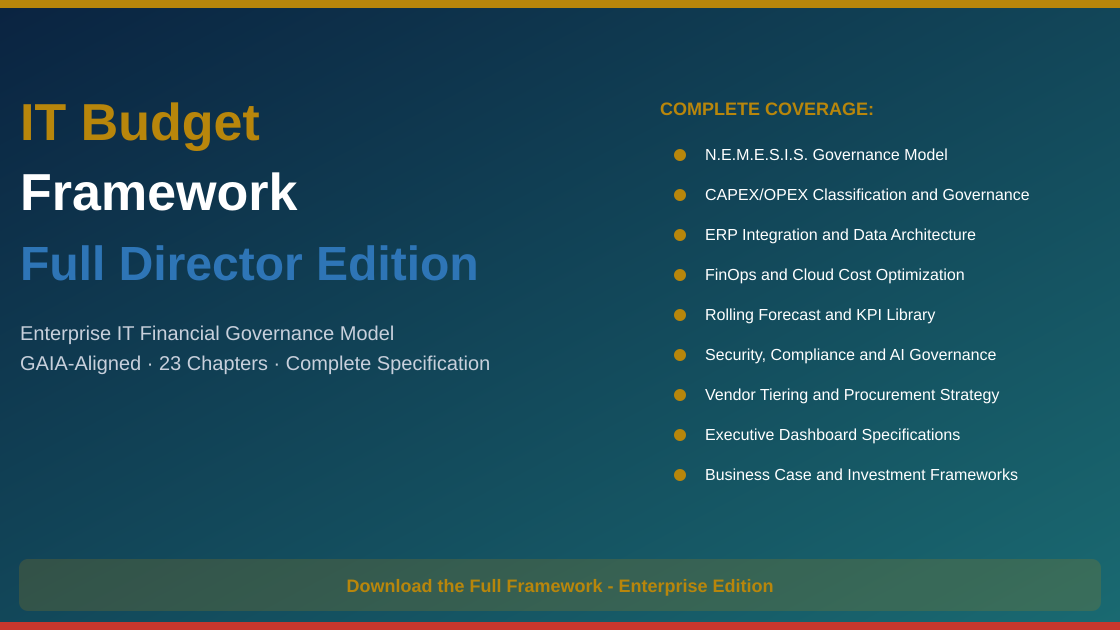
The IT Budget Framework — Full Director Edition
Created on 2026-05-26 08:06
Published on 2026-05-26 08:45
Why most IT budgets fail before the fiscal year begins
A month ago, I shared the IT Manager's Transformation Playbook — a 9-step operational roadmap for transforming IT from a cost center into a strategic capability.
The response was clear: "The roadmap makes sense. But we don't have the financial governance infrastructure to execute it."
That's exactly the problem this issue addresses.
The real reason IT budgets don't work
Most IT budgets are built the same way every year.
You take last year's number. You add 5–8% for inflation and new requests. You defend it to Finance. You get cut by 15%. You spend the year scrambling.
This is not budgeting. It's controlled guessing — and it explains why IT is perpetually seen as a cost center rather than a strategic asset.
The issue isn't the numbers. It's the absence of a governance architecture underneath them.
Without a structured framework, IT budgets lack:
A single source of truth connected to the ERP
Clear CAPEX vs. OPEX classification rules
Rolling forecast capability (not static annual planning)
Compliance-ready audit trails for DORA, NIS2, ISO 27001, SOX
Business case methodology that CFOs actually approve
FinOps execution that generates measurable cloud savings
AI cost governance before the LLM bills arrive unexpectedly
The IT Budget Framework — Full Director Edition was built to solve all of this.
What the Framework delivers
The framework is structured around N.E.M.E.S.I.S. — a 7-pillar governance architecture that covers every dimension of enterprise IT financial management:
N — Network & Infrastructure Alignment Asset inventories, DR readiness, vendor consolidation. You cannot govern what you haven't inventoried.
E — Enterprise Resource Governance ERP ledger integration, cost center mapping, G/L governance. Your IT budget must live inside the same system as the rest of the business.
M — Metrics & Cost Optimization KPI standardization, FinOps execution, license management. 30+ governance KPIs with thresholds, metadata, and escalation rules.
E — Expenditure Control CAPEX/OPEX classification governance, WBS costing, capitalization policy. The most common source of audit findings — addressed structurally.
S — Strategic Rolling Forecast Quarterly forecast cycles, cloud scaling models, business alignment. Replace the static annual budget with continuous financial intelligence.
I — IT Financial Management (ITFM) Showback/chargeback, unit economics, cost transparency. Every business unit sees what IT costs — and why.
S — Single Source of Truth Centralized data governance, ERP sync, audit-readiness. One authoritative record. No spreadsheet chaos.

The 23-chapter specification
This is not a template or a summary. It is a complete enterprise specification — 23 chapters covering:
Financial Architecture
CAPEX/OPEX classification framework with capitalization rules and ERP integration patterns
Rolling forecast model with variance escalation logic (5%, 10%, 20% thresholds)
5-year TCO model with break-even and sensitivity analysis
Business case framework: NPV, IRR, Payback Period — structured for CFO approval
Operational Governance
Enterprise Excel template specification for organizations not yet on ITFM platforms
FinOps framework across 6 domains — typically delivers 18–25% cloud savings within 12 months
IT inventory and automation standards with CMDB ↔ ERP reconciliation
Vendor tiering model: Strategic / Preferred / Tactical / Commodity
Compliance & Security Budgeting
Security budget across 4 pillars: PREVENT · DETECT · RESPOND · RECOVER
Regulatory mapping: DORA, NIS2, ISO 27001, SOX — each budget line tied to a specific control
Every compliance spend line is audit-justifiable without manual effort
AI & Next-Generation Cost Governance
LLM token billing tracking by application and use case
GPU compute cluster consumption governance
Shadow AI prevention framework
Vector database storage cost modeling
Data pipeline compute overhead — typically underbudgeted by 30–50%
Executive Reporting
Dashboard specifications for CIO, CFO, FinOps Lead, and CISO
TBM (Technology Business Management) service costing by tower
Cost allocation methodologies: Direct, Consumption-Based, Shared Overhead
The governance operating model by scale
One of the most practical sections is the governance structure calibrated by organizational size:
Small organisations: IT Manager + Corporate Accountant · Monthly review · Annual budget · Quarterly forecast
Mid-sized organisations: IT Director + CFO + PMO Director · Monthly board · Quarterly rolling forecast · Annual capital planning
Enterprise organisations: CIO + CFO + IT Financial Controller + FinOps Lead + Enterprise Architecture Board · Weekly ops · Monthly close · Quarterly forecast · Annual strategy
Most frameworks assume enterprise scale. This one is usable from day one — regardless of where you are.
International benchmarks built in
Before you can govern IT spend, you need to know where you stand:
SMB: 4–6% of total revenue on IT
Large Enterprise: 2–4% of total revenue
Financial Institutions & High-Tech: 7–12% of revenue
Per-employee baseline: $2,500–$8,000 annually
These benchmarks are integrated with the GAIA C5 Scoring Model — so your readiness assessment drives your budget envelope, not the other way around.
The GAIA alignment
The framework is fully aligned to GAIA Enterprise Blueprint v4.0.
Every chapter references the relevant GAIA Part — so if you're building on GAIA, the financial architecture slots directly into your existing governance structure. If you're not on GAIA yet, the framework works standalone.
Key GAIA integrations:
Part A (Executive Governance) → N.E.M.E.S.I.S. model and decision rights
Part I (Financial Framework) → Chapters 4–21, CAPEX/OPEX, TCO, ROI
Part J (AI Enablement) → Chapter 20.1, AI/LLM cost governance
Part K (Compliance & Security) → Chapter 20, GDPR, NIS2, ISO 27001, SOX
Who this is for
IT Directors and CIOs who need to defend their budget to the CFO with structured financial governance — not spreadsheets.
CFOs and Finance Controllers who are tired of IT budget submissions that can't be audited, traced, or benchmarked.
Enterprise Architects and PMOs who need CAPEX classification and WBS governance to be consistent and automated.
Any organization running cloud workloads without a FinOps function — before the bills arrive.
What to do with it
The IT Budget Framework — Full Director Edition is coming to Cyber-Odyssey.
Start with Chapter 0 — the N.E.M.E.S.I.S. model. Read the 7 pillars. Map them against your current state.
If you can answer all 7 without hesitation, your governance is solid.
If you can't — that gap is your roadmap.
Cyber-Odyssey launches in a few days — the framework will be available there. Stay tuned.
This newsletter is part of the NEMESIS series — IT financial governance and leadership frameworks built on the GAIA Enterprise Blueprint.
Previous issue: Issue #1 — From Cost Center to Strategic Asset: The IT Transformation Playbook